Drone Cybersecurity:
Why Resilience Defines the Future of UAV Operations
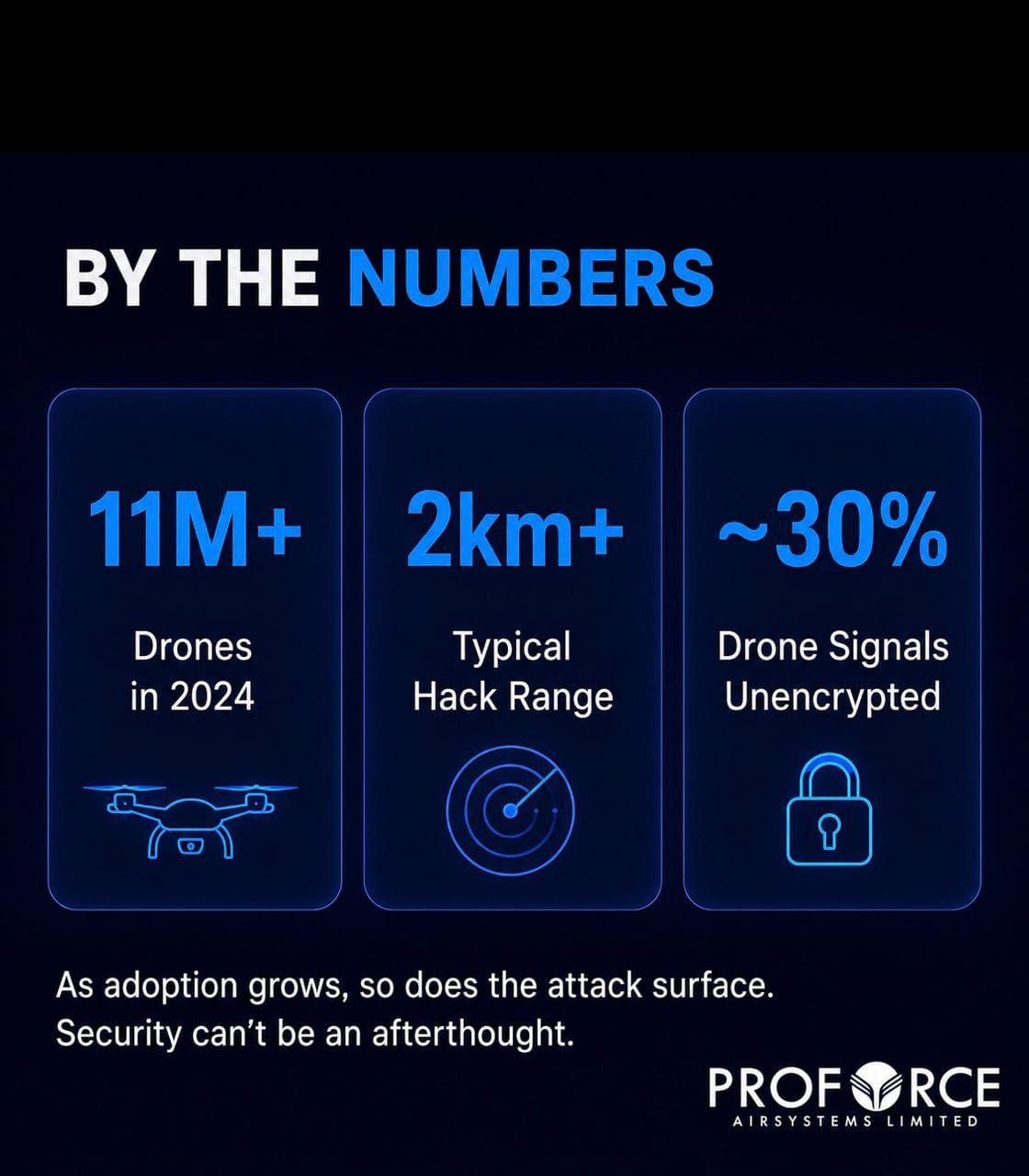
Most organisations evaluate drones on flight time and camera resolution. Few ask the harder question: what happens when a $50 signal jammer — or a sophisticated cyber intrusion — takes control of the mission?
The global UAV market has matured rapidly. Longer endurance, multi-spectral sensors, autonomous waypoint navigation — the performance curve has been steep, and rightly celebrated. But alongside every capability gain is an attack surface that grows in parallel. Every radio link, every GPS signal, every firmware update pathway and cloud integration is also a door that a threat actor can try to open.
At Proforce Airsystems, we believe the most important question in drone procurement is no longer “Can this system fly?” It is “Can this system be trusted when it matters most?”
Understanding the UAV Attack Surface
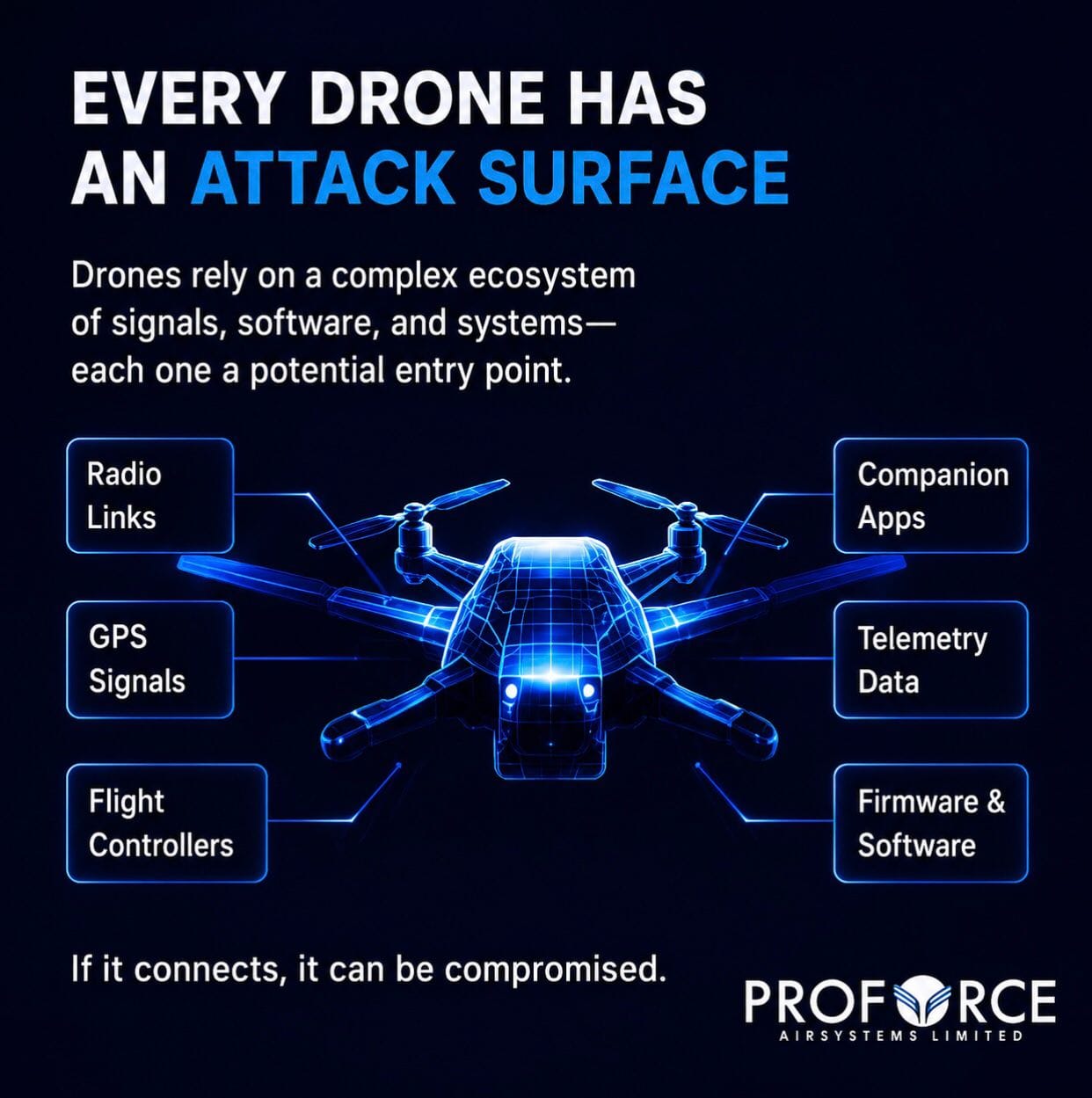
Modern drones are sophisticated networked systems. That sophistication is their greatest strength — and their greatest vulnerability. Security professionals talk about “attack surface” to describe all the points through which a malicious actor might attempt to access, intercept, or compromise a system. For UAVs, that surface is broad and growing.
Command-and-control, live video, and telemetry all travel wirelessly. These signals can be intercepted, replayed, or overpowered by adversaries using widely available hardware — without any physical proximity to the drone.
GNSS signals are the cornerstone of autonomous navigation — yet they are notoriously easy to counterfeit with low-cost SDR equipment. A spoofed drone believes it is somewhere it is not, with potentially catastrophic positional consequences.
Real-time health monitoring, payload control, and autonomous decision-making depend on persistent two-way communication — creating continuous entry points for network intrusion if that link is not hardened end-to-end.
OTA updates, companion apps, and cloud platform integrations expand operational capability. They also expand the attack surface if not secured with signed boot chains and runtime integrity verification.
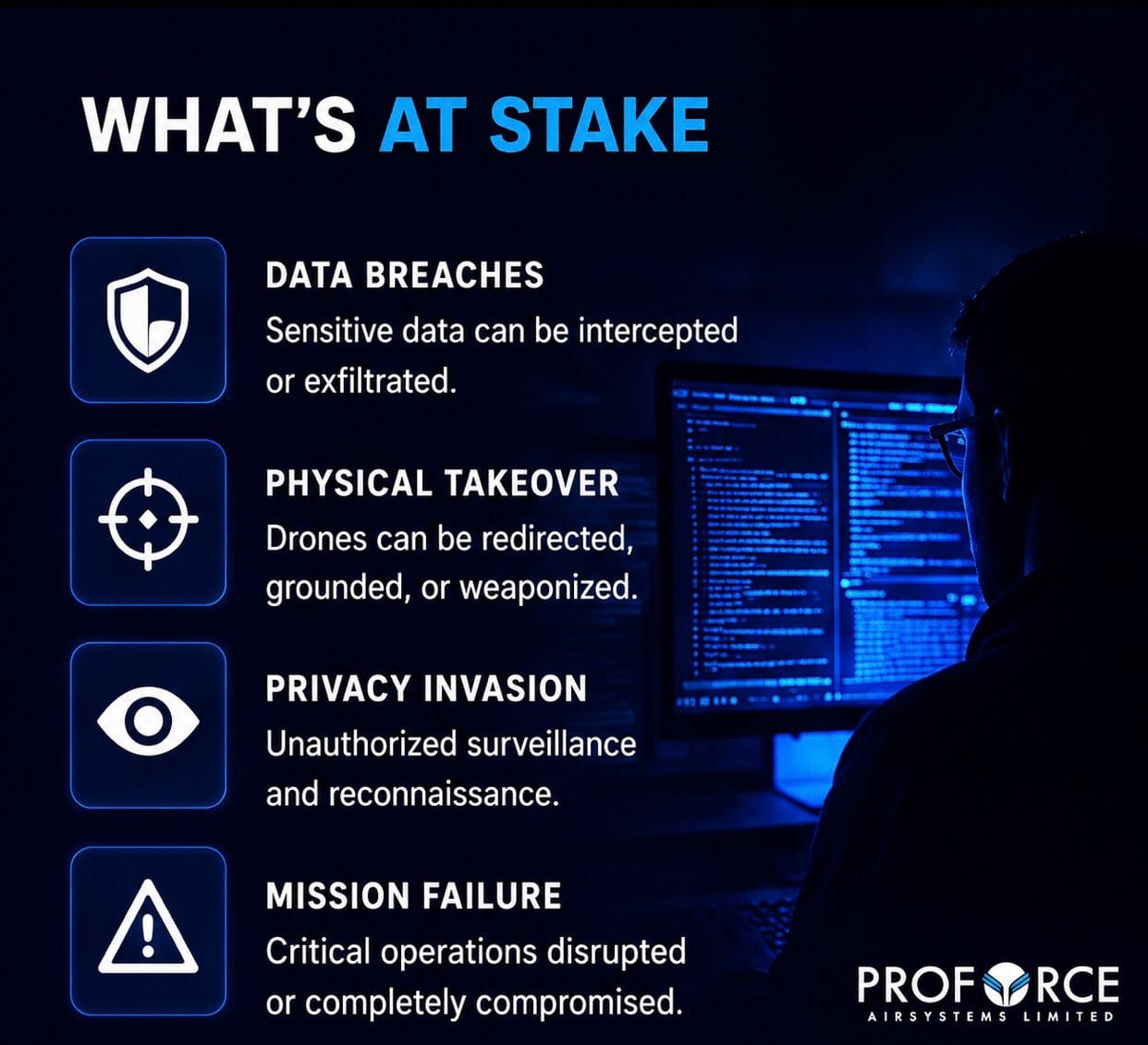
Threat actors range from low-skill recreational hackers exploiting off-the-shelf tools to sophisticated, state-sponsored groups with targeted objectives. A compromised UAV does not merely lose footage — it can become a vector for broader network infiltration, unauthorised surveillance, or physical disruption of the operation it was meant to support.
Real-World Stakes: What’s at Risk Across Industries
The consequences of a drone cybersecurity failure are not abstract. Across every sector where UAVs have become operationally embedded, a single successful attack has the potential to generate real, measurable harm.
Agriculture & Precision Farming
Precision spraying and crop health monitoring rely entirely on accurate GPS positioning. A spoofed agricultural drone can misapply expensive inputs to the wrong field, miss disease outbreaks, or cause environmental harm — with financial losses that compound over an entire growing season.
Infrastructure Inspection
Bridges, pipelines, power transmission lines, and offshore platforms demand accurate, tamper-free data. An intercepted or jammed inspection drone may produce incomplete assessments — or worse, falsified readings that delay critical maintenance and create downstream liability.
Public Safety & Emergency Response
First responders and security teams operate in high-stakes, time-pressured environments where loss of aircraft control is simply not an option. A single successful cyber intrusion during an active incident could compromise situational awareness — and lives.
Critical National Operations
Border security, industrial monitoring, strategic surveillance — in these environments, the cost of a drone compromise is measured not in lost footage, but in assets, national interests, and human safety. Performance metrics become entirely irrelevant once trust in the platform is lost.
Security by Design: The Proforce Airsystems Approach
The industry default has been to treat security as a downstream consideration — a feature to be added via software patch, a checklist item to satisfy procurement requirements. At Proforce Airsystems, we believe this is fundamentally the wrong model.
Security cannot be retrofit onto a platform that was not designed for it. It must be the architecture itself — embedded into hardware, communications stack, software systems, and operational protocols from the first design decision.
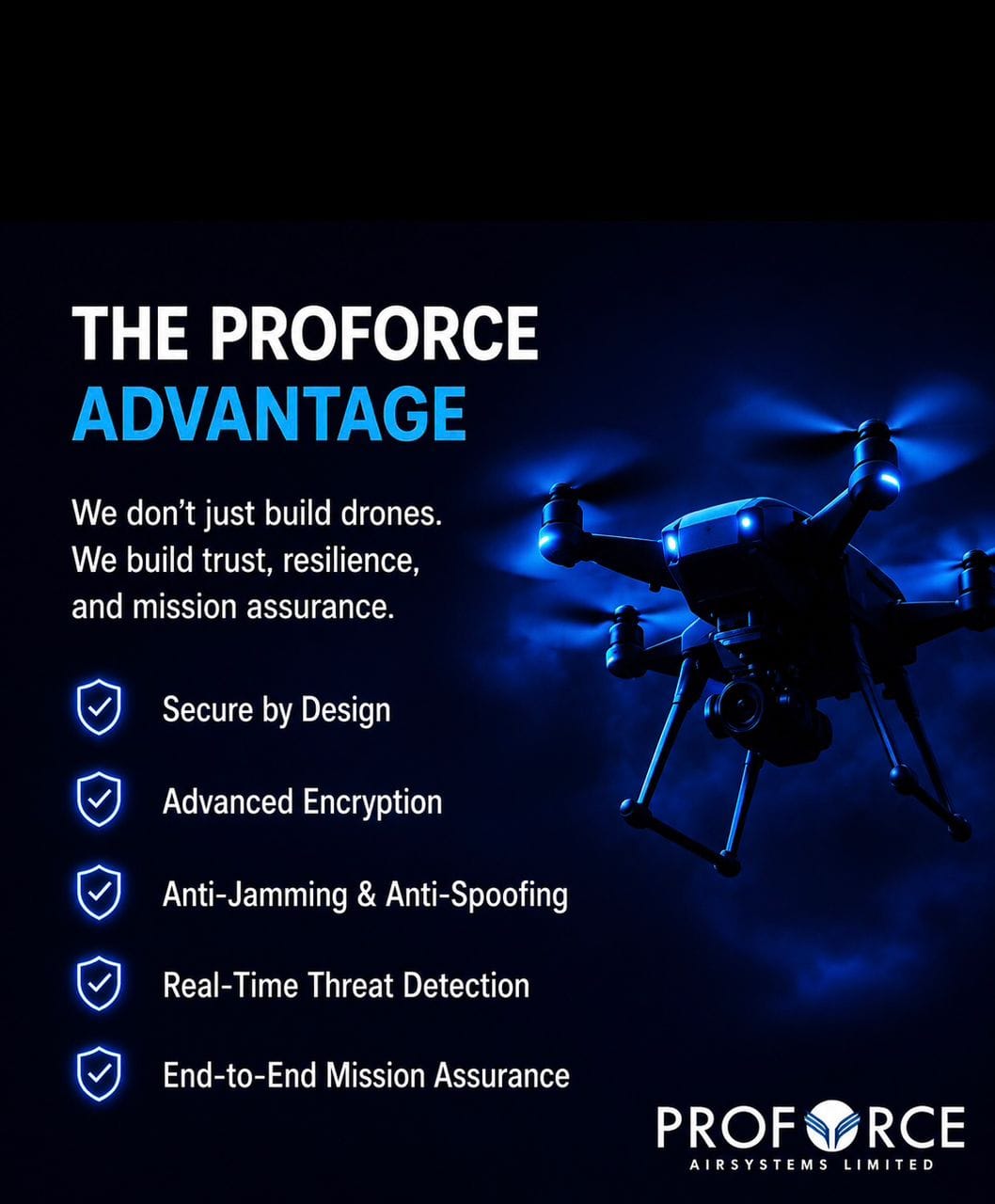
- Multi-layered anti-jamming & anti-spoofing — positional awareness maintained even in actively contested RF environments, without reliance on a single signal source.
- End-to-end encrypted communications — dynamic key management that resists both interception and replay attacks across all data and command channels.
- Hardened firmware architecture — secure boot sequences, cryptographically signed update pipelines, and runtime integrity monitoring that detect unauthorised modification.
- Air-gapped fallback modes — autonomous contingency behaviours that maintain defined safe mission states when primary links are degraded, jammed, or severed.
- Comprehensive threat modelling — proactive security posture informed by both known attack vectors and emerging threat intelligence, updated continuously.
The Shift from “It Flies” to “It’s Trusted”
The proliferation of commercial drones has brought extraordinary capability to the edge of operations — capabilities that would have required helicopter fleets or fixed infrastructure a decade ago. That democratisation is genuinely transformative. But it has also moved faster than the security culture around it.
Many organisations still evaluate UAV procurement on specifications sheets that contain no security criteria whatsoever. No mention of encryption standards, no anti-spoofing architecture, no firmware integrity validation, no contingency behaviour under link loss. These are now material omissions.
As airspace grows more crowded, more connected, and more contested, the margin for vulnerability shrinks. Regulators are beginning to demand secure-by-design standards. Mission-critical operators — those who cannot afford failure — are already there.
The organisations that demand and receive UAV systems built for trust will lead the next decade of aerial operations. Those that continue to optimise for camera resolution and flight time alone will find themselves exposed — operationally, legally, and reputationally.
Frequently Asked Questions
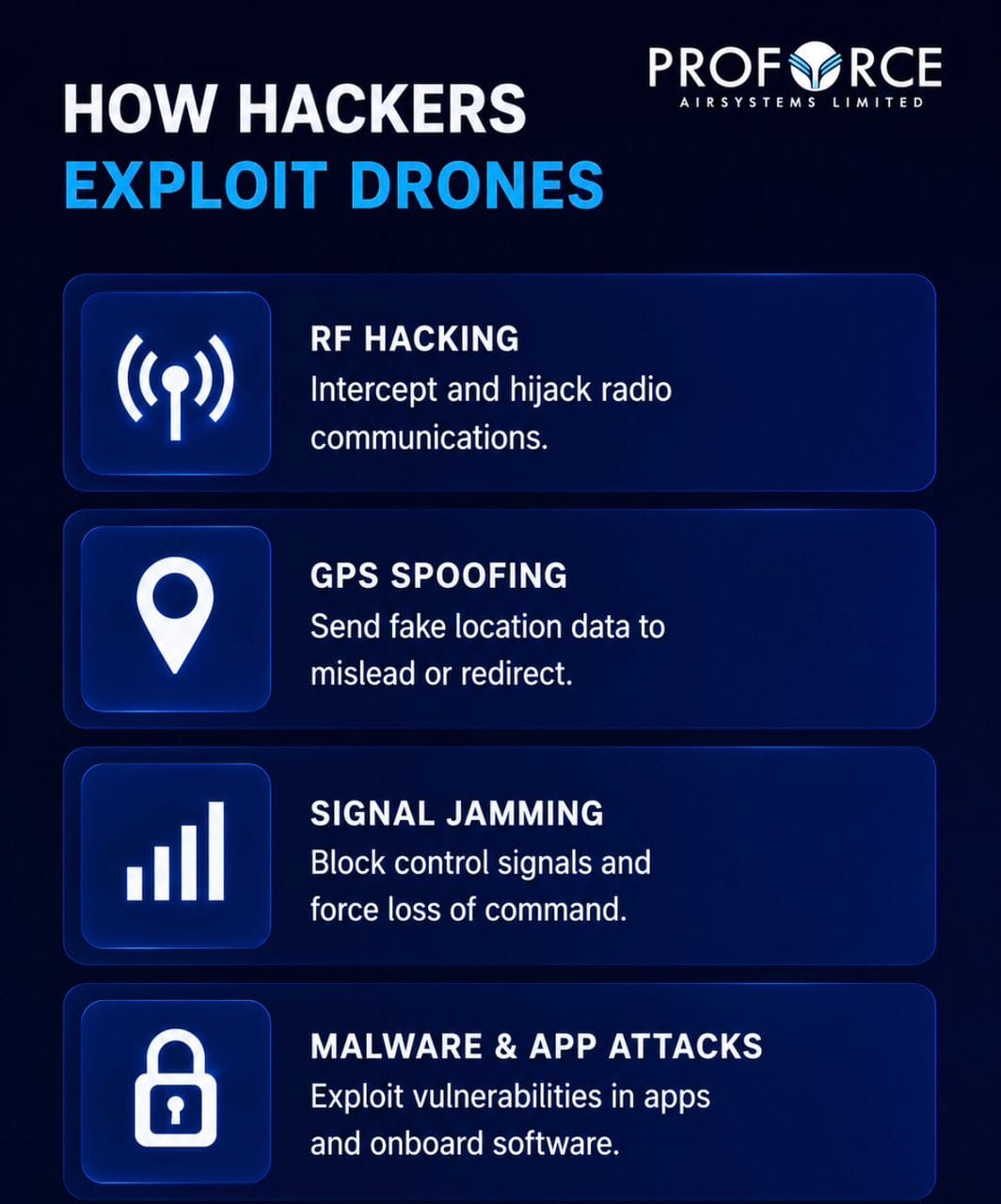
GPS spoofing involves transmitting counterfeit GNSS signals that override a drone’s legitimate positioning data. The aircraft is deceived into believing it is at a different location or altitude than it actually occupies. This can cause drones to fly into restricted airspace, deviate from planned flight paths, or lose mission-critical positioning entirely. Low-cost software-defined radio hardware makes spoofing attacks increasingly accessible to non-specialist actors.
RF (radio frequency) jamming involves broadcasting interference signals on the frequencies used by a drone’s command-and-control, video, or telemetry links. When jammed, a drone loses communication with its operator and typically falls into a pre-programmed failsafe mode — such as return-to-home or hover — which may itself be exploited. Consumer jamming hardware capable of disrupting standard drone frequencies is widely available for under $100.
Standard security approaches treat protection as a feature added to an existing platform — typically through software patches, encryption overlays, or operational procedures. Secure-by-design means security requirements are embedded into the hardware architecture, communication stack, firmware, and software ecosystem from the earliest design stage. This approach eliminates entire categories of vulnerability that cannot be adequately addressed through retrofit measures.
Any operation where UAVs are used for mission-critical functions faces meaningful cybersecurity exposure. The highest-risk sectors include precision agriculture (where positional accuracy directly affects yield and input costs), infrastructure inspection (where data integrity affects maintenance decisions), public safety and emergency response (where control reliability is a life-safety factor), and critical national operations including border security and strategic surveillance.
Ready to Move Beyond Performance?
Discover how Proforce Airsystems’ secure-by-design UAV platforms protect your operations — on the ground and in the air.
Talk to Our Team